Bacterial Genetics and Genomics, Chapter 8, Discussion topic 2. As described in Chapter 8 of Bacterial Genetics and Genomics, a two-component regulatory system has a sensory protein in the membrane that autophorphorylates when triggered by its sensory signal and a regulatory protein that is phosphorylated to do its job adjusting gene expression. In this way, somethingContinue reading “What does a two-component regulator do when it isn’t phosphorylated?”
Author Archives: drlorisnyder
A single amino acid change can have a big impact on the bacteria.
Bacterial Genetics and Genomics, Chapter 7, Discussion topic 2. It doesn’t take much to alter the sequence of a protein. Whilst some single nucleotide changes to the DNA sequence can be tolerated, others cause the gene to encode a different amino acid in the protein. Again, some of these changes to the amino acid sequence canContinue reading “A single amino acid change can have a big impact on the bacteria.”
Pathogens at low temperature and antimicrobials.
Bacterial Genetics and Genomics, Chapter 6, Discussion topic 2 and 3. Listeria monocytogenes and Escherichia coli are able to grow at low temperatures and from there be transmitted to humans and cause disease. Having antimicrobials that can work at low temperatures is important to breaking the transmission chain, particularly from food. However, most experiments onContinue reading “Pathogens at low temperature and antimicrobials.”
Regulation of a transcriptional regulator via read-through transcription of an upstream operon.
Bacterial Genetics and Genomics book Discussion Topic: Chapter 5, question 13 The regulation of gene expression means that genes are not ‘on’ all of the time, being transcribed and translated to make protein. The orchestration of gene expression is essential to the processes of the bacterial cell and can involve a number of mechanisms. OftenContinue reading “Regulation of a transcriptional regulator via read-through transcription of an upstream operon.”
Harnessing aptamers for rapid detection of bacteria and antibiotics in our food.
Bacterial Genetics and Genomics book Discussion Topic: Chapter 4, question 14 The specificity of antibody binding has been exploited for many years in a variety of technologies. Although perhaps less famous, aptamers also have high binding specificity for their targets and, being made of RNA or DNA rather than protein, are much smaller in size,Continue reading “Harnessing aptamers for rapid detection of bacteria and antibiotics in our food.”
Merging two concepts: finding genes that are both essential and core
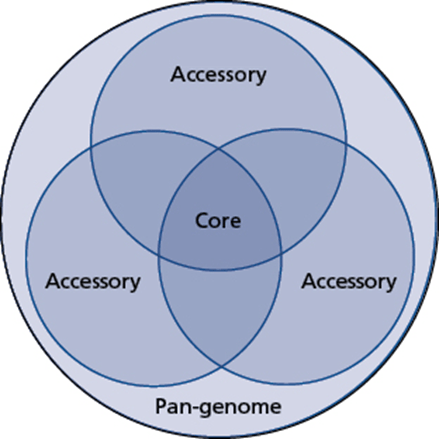
Bacterial Genetics and Genomics book Discussion Topic: Chapter 3, question 13 One of the concepts that is discussed in Bacterial Genetics and Genomics is the difference between essential genes and accessory genes. The essential genes are those that are required for the bacteria to live and the accessory genes allow it to do something elseContinue reading “Merging two concepts: finding genes that are both essential and core”
What can we learn from bacterial genome sequences that are never ‘finished’ and are left in pieces?

Bacterial Genetics and Genomics book Discussion Topic: Chapter 17, question 14 When we first started sequencing bacterial genomes, back in the 1990s, the goal was to ‘finish’, to generate a complete, closed, circularized chromosomal sequence that as accurately as possible reflected what would be seen in the bacterial cell. This process often took months, ifContinue reading “What can we learn from bacterial genome sequences that are never ‘finished’ and are left in pieces?”
Contributions of women to bacteriology: Blog for International Women’s Day 2021
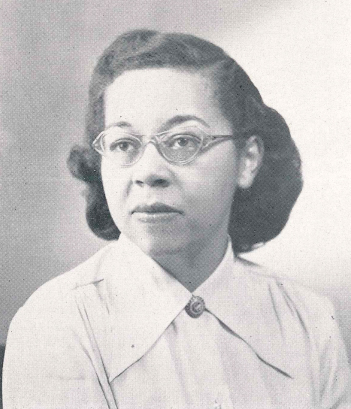
Bacterial Genetics and Genomics book Discussion Topic: Chapter 21, question 16 For these blogs I have not been including the wording of the end of chapter questions from Bacterial Genetics and Genomics. Instead, I have blogged about the general theme of these question, often highlighting a research article on the topic. However, today (8th MarchContinue reading “Contributions of women to bacteriology: Blog for International Women’s Day 2021”
Bacteria breaking the rules – again. This time, its coupled transcription – translation.
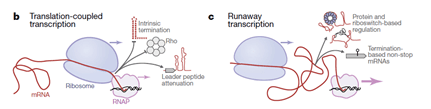
Bacterial Genetics and Genomics book Discussion Topic: Chapter 2, question 14 It has long been a defining difference that bacterial cells, like E. coli, have coupled transcription-translation and eukaryotic cells, like animals and plants, make their mRNA in the nucleus and their proteins in the cytoplasm. This is mostly the case. Mammals did break theContinue reading “Bacteria breaking the rules – again. This time, its coupled transcription – translation.”
Studying fascinating microbiomes, working in cooperation with communities, and illuminating study design.

Bacterial Genetics and Genomics book Discussion Topic: Chapter 1, question 14 I recently attended and was an invited speaker, on-line, at a conference that had a topic about short-and long-read sequencing technologies. The various talks and the panel discussion that I participated in looked at the advantages of both short-read sequencing and long-read sequencing forContinue reading “Studying fascinating microbiomes, working in cooperation with communities, and illuminating study design.”
 Bacterial Genetics and Genomics, by Lori A. S. Snyder