Bacterial Genetics and Genomics, Chapter 6, Discussion topic 2 and 3.
Listeria monocytogenes and Escherichia coli are able to grow at low temperatures and from there be transmitted to humans and cause disease. Having antimicrobials that can work at low temperatures is important to breaking the transmission chain, particularly from food. However, most experiments on bacteria happen at human body temperature, 37°C. Thus, an antimicrobial that is effective at body temperature may not be as effective at refrigerator temperature.
Acidic electrolyzed water (AEW) is an antimicrobial that functions due to its low pH, high redox potential, and chlorine. It is considered to be an environmentally friendly way to reduce bacterial burden by disinfecting materials used in healthcare, in the food chain, and in other areas.
The utility of AEW at low temperature was not known and required some investigation. In this study, two bacterial species, L. monocytogenes and E. coli were grown at low temperature. L. monocytogenes was grown at 4°C and E. coli was grown at 10°C. These cultures were then treated with AEW. The effectiveness of disinfection was assessed for the bacterial cultures and the transcriptome was investigated using RNA-seq to see if there were differences in the gene regulation at low temperature that could be associated with AEW success.
Even with increased treatment time, AEW was found to be ineffective against cold grown bacterial cultures, suggesting that the bacterial regulation that enables growth at 4 – 10°C also provides resistance to the disinfection by AEW.
By observing the bacteria, it was revealed that the cells grown at 37°C had damaged cell membranes after AEW treatment and that this led to death of the cells. Bacteria grown at the lower temperatures had less membrane damage and were more likely to survive the treatment with AEW. Cell membrane damage was correlated with protein leakage from the cell.
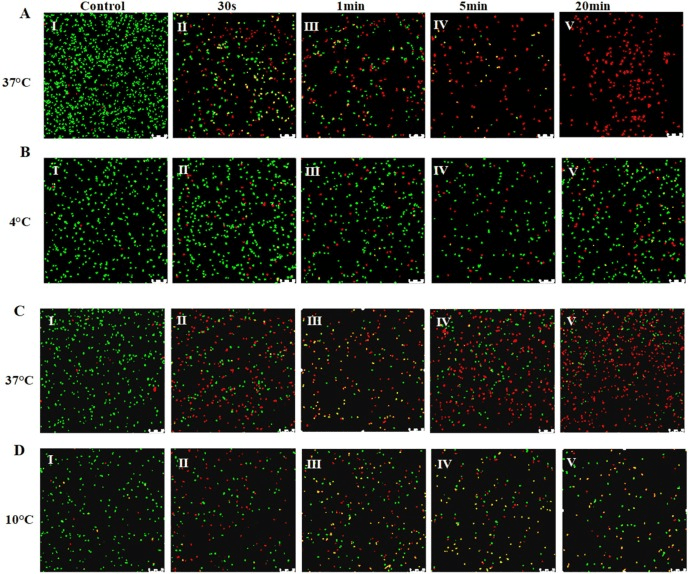
Figure showing live bacteria in green and dead in red. Over time the 37C bacteria are killed by AEW and the 4C bacteria are not.
To simulate real-life situations, the effectiveness of AEW to disinfect salmon inoculated with L. monocytogenes or E. coli was assessed. This showed that the AEW was able to work on the salmon stored at 37°C but was less effective at lower temperatures required for long-term storage and transport of salmon to consumers. This could therefore lead to infection of humans via the stored salmon, even at 4°C.
The RNA-seq data from L. monocytogenes grown at 37°C, 4°C, and 4°C after AEW treatment was analyzed. This revealed a large number of differentially expressed genes. Cold-shock protein gene cspD is known from several bacterial studies to be involved in regulation in low temperatures. It is therefore not surprising to find this gene differentially regulated. It has led to adaptation of the L. monocytogenes to oxidative and osmotic stress caused by the AEW treatment. After AEW treatment the already upregulated cspD, due to growth at 4°C, was further upregulated, demonstrating that CspD is pivotal in resistance to the antimicrobial effects of acidic electrolyzed water.
These results show that our standard experimental conditions may not be revealing the complete picture. In our food cold chain there are instances where bacteria will be growing at the low storage temperatures of the food and therefore these bacteria need to be dealt with and experiments need to be done at these temperatures.
 Bacterial Genetics and Genomics, by Lori A. S. Snyder